

Views: 0 Author: Site Editor Publish Time: 2026-04-20 Origin: Site


Property owners face a frustrating reality every single month. Rising energy utility costs eat directly into household and operational budgets. Simultaneously, traditional storage-tank heating systems waste significant energy continuously reheating unused water. Integrating a Tankless Solar Water Heater solves this exact tension. It combines the on-demand infinite supply of instantaneous heating alongside the renewable cost-offsets of a Solar Water Heater system. We must look at these systems objectively. The upfront capital expenditure is undeniably higher than standard replacements. However, the long-term return on investment is highly measurable. You can verify efficiency gains, leverage lucrative tax credits, and enjoy a vastly extended equipment lifespan. In this guide, you will learn how the integrated architecture actually works. We will break down total cost of ownership, operational reliability, and compliance advantages. You will also discover a practical evaluation framework to size your system correctly.
Dual Efficiency: Eliminates standby heat loss (saving up to 34% in energy) while leveraging solar offsets.
Risk Mitigation: Removing the storage tank eliminates the risk of catastrophic water leaks and property damage.
Longevity & TCO: Systems realistically last 20+ years, with Total Cost of Ownership (TCO) crossing into profitability within a 6 to 10-year payback window.
Compliance & Value: Offers space-saving benefits that meet modern building codes and can contribute to LEED certification.
Most buyers misunderstand how solar and tankless technologies merge. They assume engineers simply bolt two unrelated boxes to a wall. A true Tankless Solar Water Heater operates as a highly synchronized hybrid ecosystem. The setup generally functions in two primary ways depending on your chosen infrastructure.
First, we see the modern electrification approach. This involves Solar Photovoltaic (PV) arrays paired with an Electric Tankless unit. Rooftop solar panels generate raw electricity. This clean electricity flows through an inverter to power a high-efficiency electric on-demand heater directly. If the sun shines, the sun effectively heats your morning shower through electrical conversion.
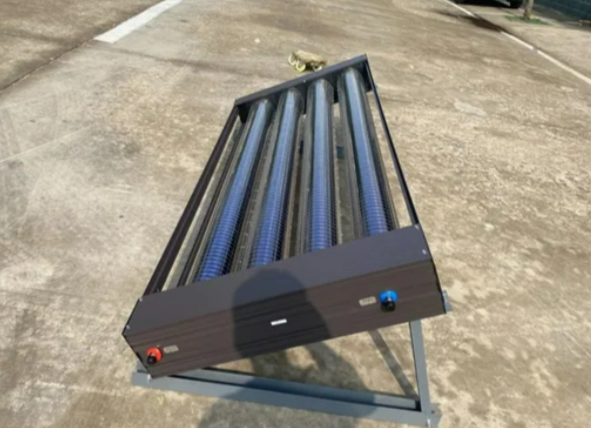
Second, we see the thermal hybrid approach. This uses Solar Thermal Pre-Heat combined with a Tankless Backup. A direct or indirect solar thermal collector sits on your roof. It captures radiant heat to warm the incoming municipal cold water. The water then flows into a gas or electric tankless unit. The tankless unit engages only to bridge the gap in temperature rise. If the sun warms the water to 90°F, the tankless unit only burns enough energy to push it to your target 120°F.
System Architecture | Primary Energy Capture | Tankless Unit Role | Best Application Scenario |
|---|---|---|---|
Solar PV + Electric Tankless | Photovoltaic (Electricity) | Primary heat source (powered by solar electricity) | Homes prioritizing full electrification and net-metering. |
Solar Thermal + Tankless Backup | Thermal Collectors (Heat) | Supplemental booster (bridging the temperature gap) | Homes maximizing localized heating efficiency without battery walls. |
This hybrid approach elegantly overcomes the flaws of standalone units. Traditional standalone Solar Water Heater setups suffer terribly on cloudy days. You often deplete the finite hot water in the storage tank quickly. Conversely, standalone tankless systems draw massive bursts of grid energy during peak operation. Combining them neutralizes these exact flaws. The solar component pre-heats the water or offsets the heavy power draw. The tankless unit guarantees you never experience a cold shower on overcast days.
We must examine the true financial impact of this integration. Removing the storage tank immediately eliminates a phenomenon known as standby heat loss. Traditional tanks waste energy 24 hours a day. They constantly fire up to maintain 40 or 80 gallons of water at a set temperature, even while you sleep or work. Eliminating this waste drives massive financial returns.
U.S. Department of Energy data provides clear benchmarks for these savings. Homes using 41 gallons or less daily see 24% to 34% efficiency gains simply by going tankless. High-usage homes pulling around 86 gallons daily still secure 8% to 14% efficiency gains. When you pair these baseline tankless savings with free solar energy, your grid dependence plummets.
However, you must consider the initial financial hurdle. Installing a Tankless Solar Water Heater requires more upfront capital than a standard weekend replacement. You typically pay a $2,000 to $4,500 premium for specialized equipment and specialized labor.
The Federal Clean Energy Tax Credit serves as a powerful financial lever to soften this blow. Property owners can legally claim a 30% Investment Tax Credit (ITC) under IRS Form 5695. This significantly reduces the initial installation shock. You deduct 30% of the total system cost directly from your federal tax liability.
Let us map out the payback period realities. You plot the subsidized installation premium against your new annual utility savings. Most households experience a realistic 6 to 10-year ROI horizon. Once you cross this breakeven threshold, the system generates pure financial profit month over month. Because these systems outlast traditional tanks, your window for accumulating net-positive savings is exceptionally wide.
Replacing a finite 40 to 80-gallon tank unlocks operational freedom. You gain a literally endless supply of hot water. The technology heats water continuously as it flows over the heat exchanger. You can run showers back-to-back all day long without waiting for a tank to recover.
However, achieving this endless supply requires proper sizing. You must evaluate your household usage patterns. Do you run the dishwasher while multiple people take showers? We call this simultaneous usage. Do you run appliances one after another? We call this sequential usage. Proper sizing ensures the unit meets peak simultaneous demands without frustrating pressure drops.
Property protection represents another massive, often overlooked advantage. Large corrosive steel tanks eventually rust. They degrade under immense internal pressure and eventually burst. This floods basements, ruins flooring, and destroys surrounding structural materials. Removing this bulky tank eliminates the risk of catastrophic water leaks completely. The absence of a large storage tank is a major property insurance benefit. You proactively remove a primary hazard from your home.
We also see vastly extended equipment lifespans. Traditional storage tanks average just 8 to 12 years of useful life. They suffer from continuous submerged scale buildup. Hard water minerals bake onto the bottom of the tank, destroying efficiency and causing metal fatigue. Tankless components avoid this chronic submerged degradation entirely. Their operational life regularly pushes past 20 years.
Best Practices for Maximum Reliability:
Flush your tankless heat exchanger annually with white vinegar to remove minor mineral scaling.
Install a pre-filter if your home runs on hard well water.
Ensure your solar thermal transfer fluids are checked every 3-5 years by a professional.
Common Mistakes to Avoid:
Assuming "endless hot water" means "infinite simultaneous flow." A unit handles volume endlessly, but only at a specific gallons-per-minute (GPM) cap.
Neglecting the annual flush, which voids many manufacturer warranties.
Space acts as a premium asset in any residential or commercial building. Wall-mounted units recover critical square footage instantly. Traditional mechanical rooms often feel cramped and chaotic. Removing the massive cylindrical bulk allows easier compliance with newer regulations. The National Appliance Energy Conservation Act (NAECA) enforces stricter air-space regulations for traditional gas-fired tanks. Going tankless circumvents these frustrating spatial limitations entirely.
Commercial and B2B applications see even greater regulatory benefits. Safety compliance is strictly non-negotiable in industrial settings. OSHA mandates highly specific requirements for emergency safety stations. For example, eye-wash facilities require reliable delivery of continuous tepid water. The temperature must remain strictly between 60°F and 100°F for a minimum of 15 minutes. A standard Solar Water Heater alone struggles to guarantee this specific output during freezing winter nights. Integrated tankless systems hit this OSHA requirement perfectly every time.
Furthermore, installing high-efficiency equipment directly impacts green building certifications. Projects utilizing a Tankless Solar Water Heater earn valuable LEED water efficiency credits. The U.S. Green Building Council (USGBC) actively rewards properties prioritizing verifiable energy offsets. Earning these credits boosts corporate sustainability metrics. It improves public relations and demonstrably increases overall property valuation.
How do you choose the exact right configuration? You must use a structured, objective evaluation framework. Avoid guessing. The core calculation relies heavily on the "Flow Rate + Temperature Rise" formula.
First, determine your peak Gallons Per Minute (GPM) demand. Add up every fixture you might realistically run simultaneously. A standard showerhead pulls 2.5 GPM. A kitchen sink pulls 1.5 GPM. If they run together, you need a unit capable of outputting 4.0 GPM.
Next, measure your local groundwater temperature. Colder northern climates require significantly more energy to achieve a target 120°F output. This specific difference is your necessary temperature rise.
Climate Zone | Average Winter Groundwater Temp | Required Temperature Rise | Impact on System Sizing |
|---|---|---|---|
Southern / Warm | 70°F | 50°F | Minimal. Standard units easily maintain high GPM flow. |
Moderate / Central | 55°F | 65°F | Moderate. Flow rates drop slightly during winter. |
Northern / Freezing | 40°F | 80°F | Severe. Requires high-BTU units or strong solar pre-heating to prevent flow restriction. |
Implementation also carries real infrastructure risks. We must address these electrical audits transparently. Upgrading to a whole-house electric tankless system requires massive instantaneous power. You often need a dedicated 220V circuit. Your electrical panel must support an additional 120 to 160 amps of available capacity. Older homes usually require expensive electrical panel upgrades before installation can even begin.
You must also select the appropriate solar technology for your climate zone. The industry divides these into three main categories:
Active Direct Systems: These use electric pumps to circulate your actual potable water directly through the roof collectors. They work beautifully, but only in strict non-freezing zones.
Active Indirect Systems: These pump a specialized anti-freeze fluid through the collectors to a heat exchanger. The fluid never touches your drinking water. They are ideal for harsh, freezing climates.
Passive Thermosiphon Systems: These rely on natural thermodynamics and gravity to move water without pumps. They are highly reliable but strictly limited to warm, sun-drenched regions.
Choosing a Tankless Solar Water Heater requires careful upfront planning and capital investment. However, it remains the absolute optimal choice for forward-thinking property owners. It perfectly serves those prioritizing long-term TCO, strict environmental compliance, and the luxury of unlimited hot water. You bypass the inherent limitations of aging storage tanks entirely. You capitalize on renewable energy without sacrificing an ounce of modern comfort.
Take actionable steps immediately to secure these benefits:
Schedule a comprehensive energy audit with a certified local contractor.
Conduct a structural and electrical assessment to map your current panel capacity.
Calculate your peak GPM using the Flow Rate + Temperature Rise formula.
Investigate overlapping local and state tax rebates to compound your federal ITC savings.
A: Yes. On cloudy days, the system relies on the grid-tied tankless unit to provide full heating. During power outages, gas-powered tankless backups can operate with a small battery backup for ignition. Fully electric tankless units require a robust whole-home battery system or generator to function during grid failures.
A: You need remarkably little interior space. The tankless unit mounts directly to a wall, taking up roughly the dimensions of a small suitcase. The solar component requires adequate, unshaded roof square footage. This eliminates the need for bulky mechanical room floor space entirely.
A: Generally, no. The solar array requires occasional visual inspections and gentle cleaning. The tankless unit requires a simple annual vinegar flush to clear minor mineral scaling. This is significantly less intensive and far less messy than draining and scrubbing a standard corrosive storage tank.


